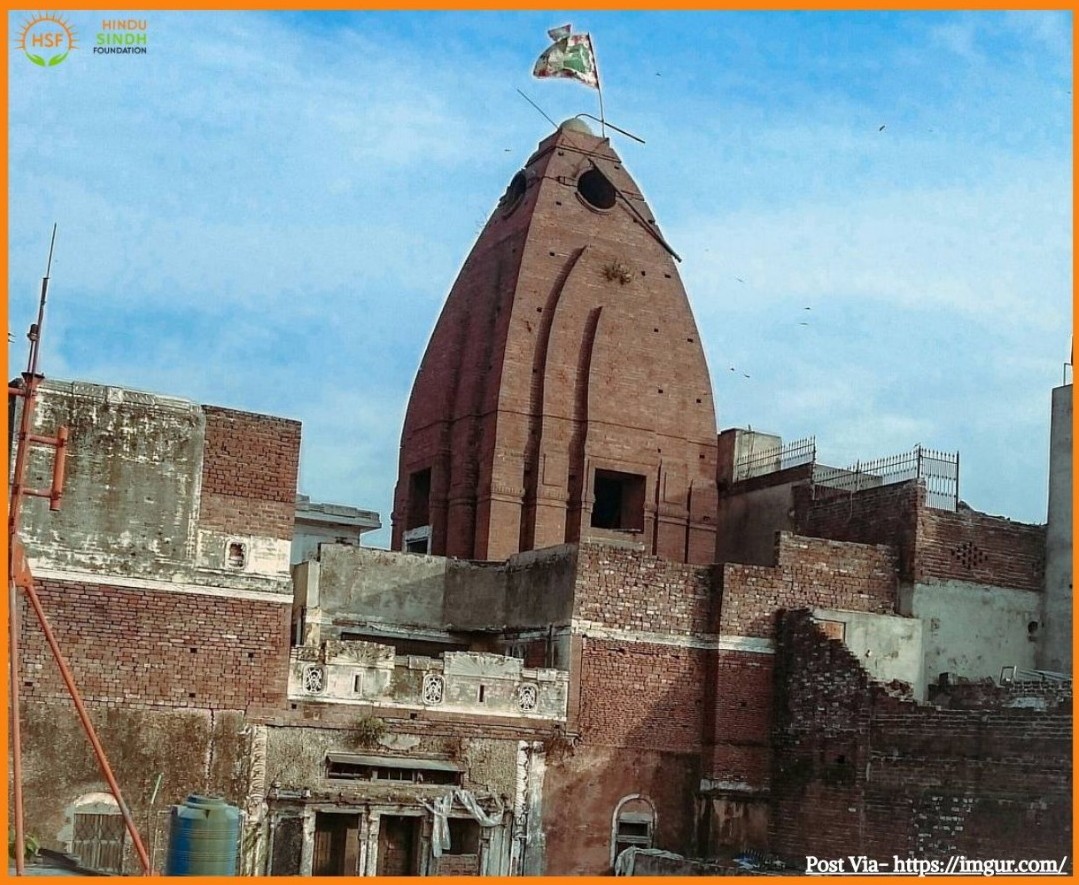
SIALKOT🇵🇰– A recent development concerning the historic Raghunath Mandir in Sialkot’s Gurr Mandi Bazaar has renewed discussion about the protection of minority places of worship and the meaning of religious harmony in Pakistan.
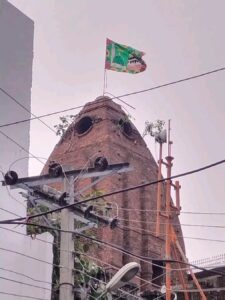
According to a statement circulating among members and supporters of the Hindu community, a religious flag associated with Islam had been displayed on the roof of Raghunath Mandir for approximately a year. The issue reportedly came to the attention of the district administration after a video highlighting the situation was shared on August 10-2026.
The statement says that Deputy Commissioner Sialkot Owais Mushtaq subsequently took notice of the matter and ordered the flag to be removed from the temple roof.
If confirmed by the district administration, the decision would represent a relatively small but meaningful administrative intervention: ensuring that a historic place of worship belonging to a minority community is treated with appropriate respect.
Raghunath Mandir is part of Sialkot’s Hindu heritage
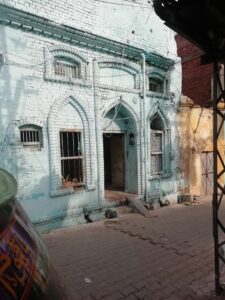
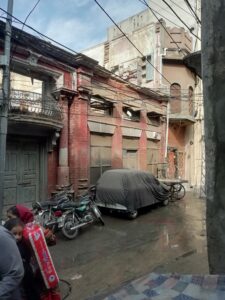
Raghunath Mandir is located in Gurr Mandi Bazar in central Sialkot and is listed among the city’s surviving Hindu religious sites. Online geographical and heritage listings identify the temple at Gurr Mandi Bazar and describe it as a historic pre-Partition Hindu temple.
The temple is also separately identified in lists of Hindu temples in Sialkot, alongside other historic sites including Puran Bhagat Temple, Jagannath Temple and the better-known Shivala Teja Singh Temple.
Raghunath Mandir is therefore not simply an abandoned building in an old market. It is part of the physical record of Sialkot’s religious and social history.
Before Partition in 1947, Sialkot was home to substantial Hindu and Sikh communities. The city’s surviving temples and other religious structures provide reminders of that multicultural past.
A flag on a temple roof became a matter of concern
The immediate controversy concerns the reported presence of a Muslim religious flag on the roof of the Hindu temple.
A local historical study of Sialkot’s Hindu heritage, available online, specifically describes Raghunath Temple as being on Gurr Mandi Bazaar Road and states that a Muslim flag was visible on its roof. The same account says the temple was closed and that access to the building was restricted.
That older account is significant because it suggests that the issue surrounding the temple’s roof is not entirely new. However, it does not establish precisely when the flag mentioned in the recent report was installed or whether it was the same flag referred to in the recent complaint.
The distinction is important. A responsible news report should not turn an unverified social-media allegation into an established historical fact.
What the recent report claims
The statement circulating online says Hindu community members had been distressed by seeing the flag on the temple for about a year.
According to the statement, a video posted on August 10 brought the matter to the attention of Deputy Commissioner Owais Mushtaq. The administration is then said to have ordered the removal of the flag.
The statement thanked the deputy commissioner and described the reported action as an example of religious harmony and mutual respect, particularly in connection with Pakistan’s Minority Day, observed on August 11.
At the time of publication, however, an independent official notification or detailed report from the Sialkot district administration confirming the sequence of events was not located. The report should therefore be attributed to the community statement unless documentary confirmation is obtained.
Owais Mushtaq and the Sialkot administration
There is independent confirmation that Owais Mushtaq is currently serving as Deputy Commissioner Sialkot. Punjab government reshuffling reports published in July 2026 said that Owais Mushtaq was appointed to the post after the transfer of Saba Asghar Ali.
More recent reporting also places him at official events in Sialkot. The Associated Press of Pakistan reported in July 2026 that Deputy Commissioner Owais Mushtaq attended the inauguration of the Faiz Ahmed Faiz Flyover in the city.
This confirms his current administrative position, but it does not by itself verify the reported temple intervention. That part of the story should remain attributed until an official statement, order or contemporaneous report becomes available.
Why religious symbols around places of worship matter
The dispute raises a broader question about how religious sites are treated in a society where different communities share the same public space.
For a worshipper, a temple, mosque, church or gurdwara is not simply a physical structure. Its symbols, architecture and surroundings carry religious meaning.
Consequently, placing a religious symbol belonging to one faith on a place of worship associated with another can understandably become sensitive, particularly where the affected community already feels vulnerable because of its minority status.
The principle should be applied consistently.
A mosque should be protected from inappropriate religious symbols just as a Hindu temple, Sikh gurdwara or Christian church should be. Religious harmony cannot mean demanding respect for one’s own sacred places while ignoring the concerns of others.
It means applying the same standard to everyone.
Sialkot has a wider history of protecting minority heritage
The Raghunath Mandir controversy comes against the background of broader efforts to preserve Sialkot’s historic Hindu and Sikh religious sites.
One of the best-known examples is Shawala Teja Singh Temple, another Hindu temple in Sialkot. In 2019, the historic temple was reopened after having remained closed for decades. Dawn reported that the government began rehabilitation work and allocated funds for restoration, while later reporting documented the handover of the renovated temple to the Hindu community for worship.
The two temples should not be confused: Shawala Teja Singh Temple and Raghunath Mandir are separate sites. Raghunath Mandir is in Gurr Mandi Bazar, while Shivala Teja Singh is in Kashmiri Mohalla. Contemporary listings identify both separately.
This distinction is particularly important because reports about the reopening of the ancient Sialkot temple in 2019 sometimes circulate online alongside information about Raghunath Mandir.
From controversy to constructive action
The reported removal of the flag, if confirmed, need not be viewed solely through the lens of confrontation between religious communities.
It can instead become an example of how local administration can respond to legitimate concerns before they develop into a larger dispute.
The most constructive response is straightforward: preserve historic places of worship, respect their religious identity, investigate complaints impartially and ensure that the same standards are applied to every community.
For Sialkot, this is particularly relevant. The city possesses a remarkable but vulnerable religious heritage, including Hindu temples that survived the upheaval of Partition and the decades that followed.
Preserving these buildings is not about favouring one religion over another. It is about acknowledging the history of the city itself.
A test of interfaith harmony
The Raghunath Mandir episode offers a simple test of what religious harmony should mean in practice.
Harmony is not merely a slogan used on Minority Day or at official ceremonies. It is demonstrated through everyday respect: protecting places of worship, listening when minority communities raise concerns and ensuring that religious identity is not treated as something that matters only when it belongs to the majority.
If the reported intervention by the Sialkot administration is confirmed, it deserves recognition as a practical example of that principle.
But the larger responsibility remains with society as a whole.
A temple should be allowed to remain a temple. A mosque should be respected as a mosque. A church should be protected as a church. And every community should be able to ask for that respect without having to prove that its feelings matter more than anyone else’s.
That is the foundation on which genuine religious harmony can be built.