Subheading: Kamran Masih was detained following a blasphemy allegation in Sheikhupura district, Punjab. The subsequent attack on his home and pharmacy has sparked renewed concerns over the safety of religious minorities and the protection of citizens from mob violence.
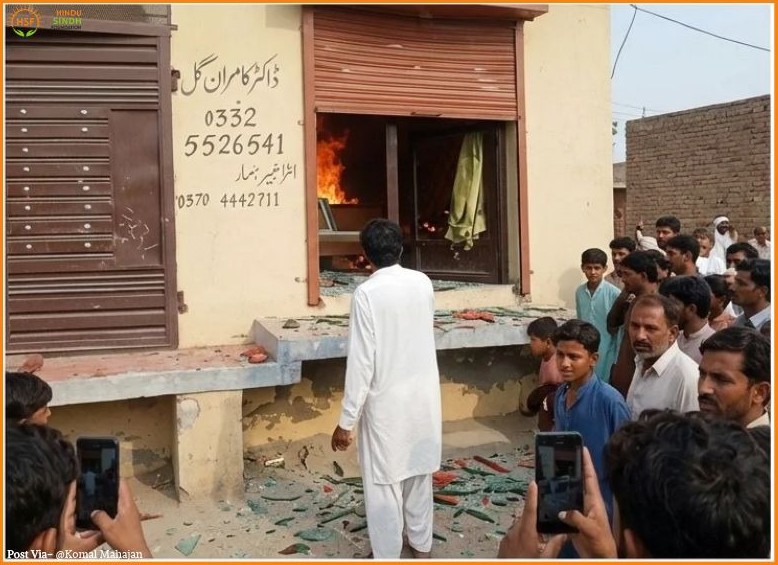
SHEIKHUPURA🇵🇰- October 10, 2026: More than 35 Christian families have reportedly fled their homes in fear after a mob set fire to the home and pharmacy of Kamran Masih, a Christian pharmacist in Punjab’s Sheikhupura district, following an allegation of blasphemy, according to media reports.
Masih, a 40-year-old father of three who operated a small pharmacy in Gharial Kalan village near Narang Mandi, was arrested by police on the night of October 8. The arrest reportedly followed accusations that he had shared allegedly blasphemous content in WhatsApp groups.
According to reports published by Christian Daily International–Morning Star News and carried by other news outlets, dozens of people gathered outside Masih’s shop and adjoining residence on Friday, October 9. Some members of the crowd reportedly set the properties on fire, raising fears of further attacks against the village’s Christian residents.
The incident has once again drawn attention to the vulnerability of religious minorities in Pakistan when allegations of blasphemy trigger public anger and threats of violence.
Arrest Followed by Mob Attack
Local sources cited in media reports said Masih was taken into custody before the attack on his property. As news of his arrest spread, members of his family and other Christian residents reportedly began leaving the village, fearing retaliation.
More than 35 Christian families were reported to have fled their homes amid concerns for their safety.
The precise circumstances surrounding the alleged social media content remain unclear. Reports have described the material as a video allegedly shared through WhatsApp groups, but the allegation has not been established as fact.
The specific legal provisions invoked against Masih were also not confirmed in the reports available at the time of publication.
The distinction is important: an allegation is not proof of an offence, and any criminal accusation must be investigated through lawful procedures rather than settled through threats or violence.
Police Deploy Personnel as Fear Spreads
According to reporting by Christian Daily International–Morning Star News, police personnel were deployed to the area to maintain order and protect Christian residents and their properties.
An official at the Sheikhupura district police chief’s office reportedly confirmed that an investigation was under way but declined to provide further details, citing the sensitivity of the situation.
It was not immediately clear whether all displaced families had returned, what assistance was being provided to those who fled, or whether the damaged home and pharmacy would receive compensation.
Further clarification is needed from district authorities regarding the registered criminal case, the extent of the property damage, the safety of Masih’s family and the measures being taken to prevent further violence.
Authorities also face the task of identifying and holding accountable anyone responsible for arson, intimidation or other criminal acts, regardless of the religious or social identity of those involved.
A Wider Pattern of Fear Among Religious Minorities
The Sheikhupura incident has revived longstanding concerns about the consequences of blasphemy accusations in Pakistan, where religious sensitivities can create an atmosphere of fear for accused individuals and their communities.
A major example occurred in August 2023 in Jaranwala, in Punjab’s Faisalabad district. After allegations that two Christian men had desecrated the Quran, mobs attacked Christian neighbourhoods, damaging homes and setting churches on fire. The violence forced residents to flee and prompted widespread condemnation. The Associated Press documented the attacks and the subsequent deployment of security personnel.
The Jaranwala violence demonstrated how an allegation against individuals can escalate into collective punishment against an entire religious community.
Human rights advocates have repeatedly warned that blasphemy accusations can expose people to threats, vigilante violence and lengthy legal proceedings. They have also raised concerns about the possibility of such allegations being misused in personal disputes.
In August 2026, Reuters reported that Pakistan had experienced a substantial decline in registered blasphemy cases amid a government crackdown on hard-line Islamist groups. However, the report also highlighted the persistent fears of religious minorities, noting that the threat of violence can remain even when security conditions improve.
The reported attack in Sheikhupura underscores why continued protection and accountability remain essential.
The Question of Equal Protection Under the Law
Pakistan’s Constitution provides important guarantees concerning religious freedom and equality before the law. Article 20 protects the right to profess, practise and propagate religion, subject to constitutional limitations, while Article 25 establishes equality of citizens before the law and equal protection of the law.
These guarantees raise an urgent practical question: how effectively are citizens protected when a religious allegation places them at risk of mob violence?
Law enforcement authorities must investigate accusations impartially, protect those at risk and prevent crowds from taking the law into their own hands. At the same time, anyone accused of a criminal offence is entitled to due process, and those responsible for attacks on homes, businesses or places of worship must be investigated in accordance with the law.
The protection of minorities cannot depend solely on the deployment of police after violence has begun. Prevention, timely intervention, impartial investigations and effective legal accountability are also necessary.
A Family’s Safety and Livelihood at Stake
For Masih and his family, the reported incident involves more than a criminal investigation. Their home and pharmacy represent a place of residence, a livelihood and the foundation of everyday family life.
The reported displacement of dozens of Christian families also raises concerns about access to shelter, essential services, employment and education while residents remain away from their homes.
As of October 10, the full extent of the damage, the long-term situation of displaced families and the outcome of Masih’s case remained unclear in the reports reviewed for this article.
The immediate priorities are clear: protect the affected families, establish the facts through a transparent investigation, ensure lawful proceedings for Masih and investigate those responsible for the reported attack.
Who Will Protect Pakistan’s Minorities?
The events reported in Sheikhupura pose a question that extends beyond one village or one accused man: can every citizen rely on the protection of the state when religious tensions escalate?
No allegation should place a person or an entire community outside the protection of the law. Nor should an individual’s arrest be treated as permission for others to threaten, assault or destroy property.
For Pakistan’s Christian community and other religious minorities, lasting security requires more than assurances after an incident. It requires protection before violence occurs, equal treatment under the law and accountability when crimes are committed.
The investigation into the case of Kamran Masih will be an important test of those responsibilities. Until the allegations are examined through a fair legal process, the facts are established and affected families can safely return, questions about justice and protection will remain unanswered.
For more updates and detailed coverage of this case and other issues affecting the Hindu and Sindhi communities in Sindh, Pakistan, stay tuned to Sindh Renaissance.