Residents say generations-old homes are being threatened; community members demand legal notices, documentation and answers from authorities
KARACHI🇵🇰: Fear and uncertainty have gripped members of the Hindu community living in Karachi’s Jacob Lines area after residents say they have been pressured to vacate their homes on the grounds that the properties stand on allegedly encroached land.
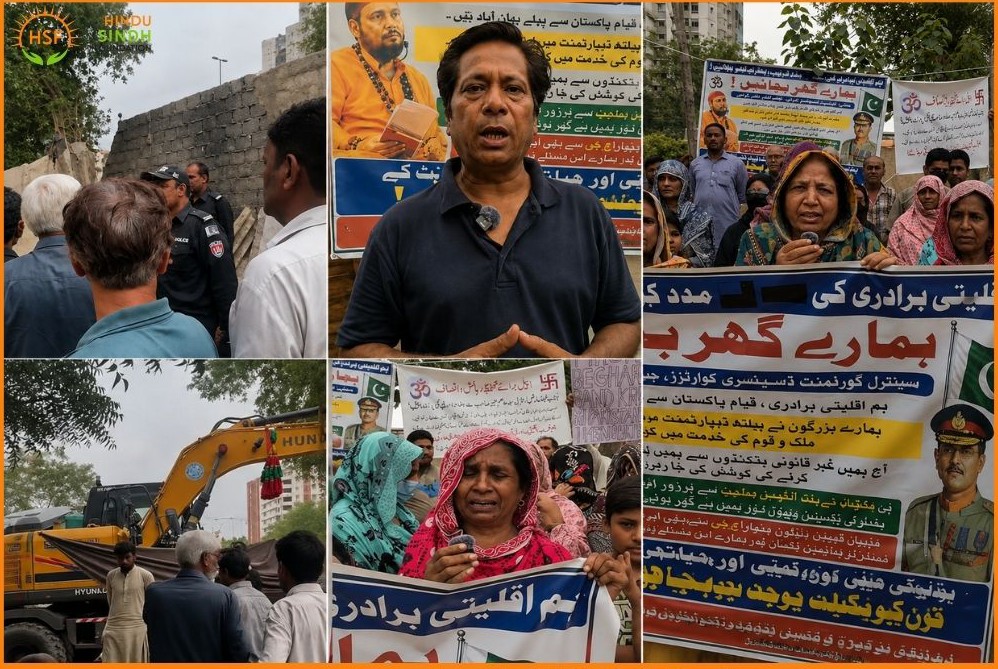
Videos and photographs circulating from the area show residents confronting police personnel and officials near what appears to be demolition machinery. Separate footage shows members of the Hindu community, including women, speaking during a protest while holding banners appealing to the authorities to protect their homes.
The residents’ account raises a fundamental question: can families that say they have lived in these quarters for three or four generations suddenly be treated as illegal occupants without a transparent legal process?
Generations of residents
According to accounts given by residents and community representatives, several families living in the area trace their presence back to the generations immediately following Partition, with some saying their ancestors worked as junior or sanitation staff associated with government health facilities and were provided accommodation as service quarters.
The residents maintain that these were not houses occupied recently or through a new encroachment. Rather, they say their families have lived in the locality for decades and that their children and grandchildren were born and raised there.
That claim, however, needs to be established through official land, allotment, employment and municipal records.
Jacob Lines itself has a long history of government and military accommodation. Historical material describes government quarters in the locality as well as the area’s transformation following Partition. A World Bank account of Karachi’s urban development described Jacob Lines as a centrally located area where wooden barracks had originally been built as military quarters and where large numbers of low-income residents subsequently lived.
The area’s history therefore makes the question of ownership and occupancy considerably more complicated than simply labelling long-term residents as “encroachers.”
A question for the Health Department
The most important issue now is documentation.
If the property belongs to the government and the occupants are unauthorised, residents deserve to be shown the relevant land records, notices and legal orders. If the houses were historically allotted as service quarters, the government should clarify who was allotted the accommodation, under what rules, whether those allotments were subsequently transferred or inherited, and what legal status the present occupants hold.
The residents also claim that they have not been provided with a proper legal notice ordering them to vacate.
That allegation should be independently verified by obtaining a copy of any eviction, demolition or encroachment notice issued by the relevant department.
As of the time of publication, this report has not independently established that the Sindh Health Department has issued a final eviction order against the Hindu families in question.
Why Jacob Lines matters
Jacob Lines is not an isolated settlement. It is an established part of Karachi’s Jamshed Town area, and the locality has been documented in official and urban-planning material for decades. The area has also been associated with government institutions and hospitals. Current listings place several healthcare facilities in and around Jacob Lines, including Hashmanis Hospital and Taj Medical Complex.
Historical records further show that Jacob Lines was part of Karachi’s post-Partition housing story. One historical account records refugee camps in Jacob Lines in the years following Partition, while other scholarship documents the upheaval surrounding Hindu properties and government housing during that period.
This history makes it particularly important that present-day property disputes be dealt with through records and law rather than through pressure or intimidation.
Residents question use of police and heavy machinery
The images supplied to this publication appear to show police personnel at the site and a Hyundai excavator surrounded by residents. Protest footage also shows community members raising their concerns publicly.
If machinery has indeed been brought to the location for demolition or clearance, authorities should clarify:
- Who ordered the operation?
- Which department owns or administers the land?
- What is the legal status of the houses?
- Were residents served written notices?
- Was a court order obtained, if required?
- Has any alternative accommodation or rehabilitation been offered?
- Why are police and demolition machinery being deployed before the dispute is publicly clarified?
- Is the action directed specifically at particular properties, or is it part of a wider anti-encroachment operation?
These are legitimate questions irrespective of the religious identity of the residents.
The larger minority-rights concern
For Pakistan’s Hindu minority, the dispute carries significance beyond a property disagreement.
A family that has lived in the same neighbourhood for generations can reasonably fear that losing its home will also mean losing its community, social networks and sense of security.
At the same time, allegations of illegal occupation cannot simply be dismissed because residents have lived somewhere for decades. The answer must come from documents, title records, allotment records and due process.
If the government has evidence that the land was illegally occupied, it should make that evidence public and follow the law.
If residents possess valid historical allotments or other legal rights, those documents should likewise be recognised and protected.
Political representatives urged to intervene
Community representatives and elected members belonging to the Hindu community should seek an immediate meeting with the relevant authorities and demand clarity over the status of the properties.
Members of the National Assembly, Sindh Assembly and local government representatives should ask the provincial administration to conduct a transparent inquiry and ensure that no family is displaced without due legal process.
The Sindh government and Health Department should also publicly state whether any eviction or demolition operation has been authorised in Jacob Lines and, if so, under what legal authority.
A question that deserves an answer
The dispute ultimately comes down to a simple question:
Are these families illegal occupants, as alleged, or are they long-term residents whose families were historically provided accommodation and whose rights have never been properly resolved?
That question cannot be answered by a bulldozer.
It can only be answered through land records, allotment documents, official notices, court orders and a transparent investigation.
Until those records are placed before the public, allegations on either side should be treated cautiously.
For families already living with uncertainty, the demand is straightforward: show us the law, show us the documents, and give us due process before taking away our homes.
For more updates and detailed coverage of this case and other issues affecting the Hindu and Sindhi communities in Sindh, Pakistan, stay tuned to Sindh Renaissance.