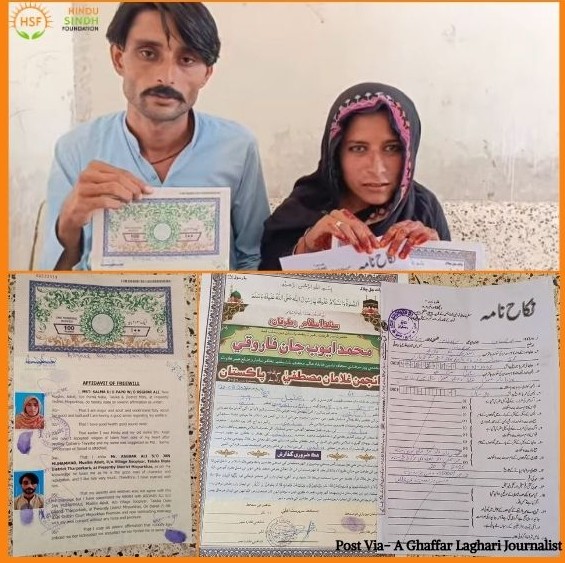
MIRPURKHAS, Sindh🇵🇰– A woman from Mithi taluka of Tharparkar district, who says she was formerly Hindu and has recently embraced Islam, has married Asghar Ali son of Jan Muhammad at the District Court premises in Mirpurkhas and appealed to police authorities for protection.
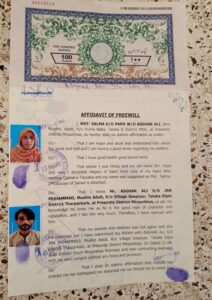
According to an affidavit of free will dated August 21, 2026, the woman identifies herself as Mst. Salma, daughter of Papo, a resident of Purna Naka, Mithi, and currently residing in Mirpurkhas. In the document, she states that her former name was Kajal and that she accepted Islam and adopted the name Salma.
She says she is an adult, in good health and of sound mind, and understood the implications of her decision.
Affidavit says marriage was voluntary
In the affidavit, Salma states that she knows Asghar Ali, son of Jan Muhammad, a resident of Village Soopiyar in Taluka Diplo, Tharparkar, and describes him as a man of good character and reputation.
She says that she married him because she wanted to do so and that her parents and relatives did not agree with the marriage.
“I have solemnized my Nikah with Asghar Ali … with my own consent without any force and pressure,” the affidavit states.
She further declares that nobody kidnapped, abducted, enticed or forced her to make the statement.
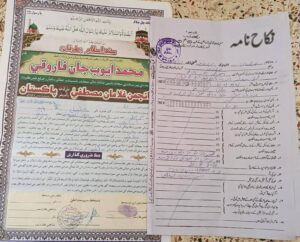
The document also states that a copy of her conversion certificate, or Sanad, was attached to the affidavit.
Appeal for protection
In an interview attributed to journalist Abdul Ghaffar Leghari, Salma reportedly appealed to law-enforcement authorities, including the SSP Tharparkar, to provide protection to her following the marriage.
The protection request comes against a sensitive backdrop in Sindh, where disputes surrounding the conversion and marriage of Hindu women and girls have repeatedly generated allegations of abduction, coercion and forced religious conversion.
However, there is currently no independent evidence available to establish that Salma herself was abducted or forcibly converted. Her affidavit contains the opposite assertion: that she converted and married voluntarily.
For that reason, any allegation of coercion in this particular case should be treated as an allegation until investigated and established by competent authorities.
A recurring and deeply contested issue in Sindh
The case comes amid continuing concerns over the safety of Hindu women and girls in Sindh.
The Human Rights Commission of Pakistan (HRCP) has documented persistent allegations involving the disappearance of non-Muslim girls followed by their reappearance after conversion to Islam and marriage to Muslim men. Its recent reporting says the issue has been particularly concerning among economically vulnerable Hindu communities in Sindh.
The HRCP has also reported that Hindu communities in Sindh face broader concerns involving discrimination, violence, insecurity and migration.
In April 2026, UN human-rights experts likewise expressed concern over what they described as continuing patterns of abduction and forced religious conversion through marriage involving women and girls from minority communities in Pakistan. According to the UN experts, around 80 percent of the incidents recorded in 2025 occurred in Sindh, while approximately 75 percent of affected women and girls were Hindu and 25 percent Christian. The experts stressed that any change of religion must be free from coercion and that marriage must be based on full and free consent.
Recent cases have heightened scrutiny
The issue has also come before courts in Sindh in recent months.
In February 2026, the Thatta Model Criminal Trial Court declared the marriage of a 16-year-old Hindu girl void in a case involving allegations that her age had been misrepresented in conversion and marriage documents. The court emphasized the protection afforded to minors under Sindh’s child-marriage legislation and ordered protective custody for the girl.
Another case reported in January 2026 involved a Hindu girl who told a court that she had voluntarily converted to Islam and married a Muslim man. Her family disputed that account and alleged that she had been enticed or abducted. The court sent her to a shelter while her age was verified.
Such cases demonstrate why courts and investigators must carefully establish a person’s age, freedom of choice, circumstances of conversion and circumstances surrounding the marriage, rather than relying solely on competing claims from families or spouses.
What the law says
Sindh has specific legislation concerning child marriage. The Sindh Child Marriages Restraint Act, 2013, which came into force in 2014, prohibits marriage involving a person under the age of 18 and provides penalties for those involved in arranging or solemnising such marriages.
The accompanying Sindh Child Marriage Restraint Rules, 2016 require the person conducting a marriage to verify that both parties are at least 18 years old. The rules also provide for CNIC documentation or, where necessary, medical verification of age.
The age issue is therefore particularly significant in cases involving alleged conversion and marriage. In Salma’s case, the affidavit explicitly describes her as an adult, but her age and other underlying documentation would ultimately be matters for the relevant authorities to verify.
Protection must apply to everyone
The circumstances surrounding Salma’s case remain a matter for the relevant authorities to establish independently.
If she has converted and married voluntarily, she is entitled to protection of her life, liberty and lawful choices. If evidence emerges that she was threatened, abducted, coerced or otherwise deprived of her freedom, those allegations must likewise be investigated and dealt with according to law.
The broader concern raised by minority-rights groups is that freedom of religion, freedom from coercion, women’s rights and equal protection under the law must apply regardless of a person’s faith.
For communities in Tharparkar and elsewhere in interior Sindh, the credibility of the justice system depends on authorities investigating every such case impartiall- protecting an adult woman’s voluntary choice while also ensuring that no woman or girl is subjected to abduction, forced conversion, forced marriage or intimidation.
For more updates and detailed coverage of this case and other issues affecting the Hindu and Sindhi communities in Sindh, Pakistan, stay tuned to Sindh Renaissance.