Lahore emerges as the worst-affected district as Christians become the majority of reported victims in 2026
November 26, 2026 | Testimonies Global
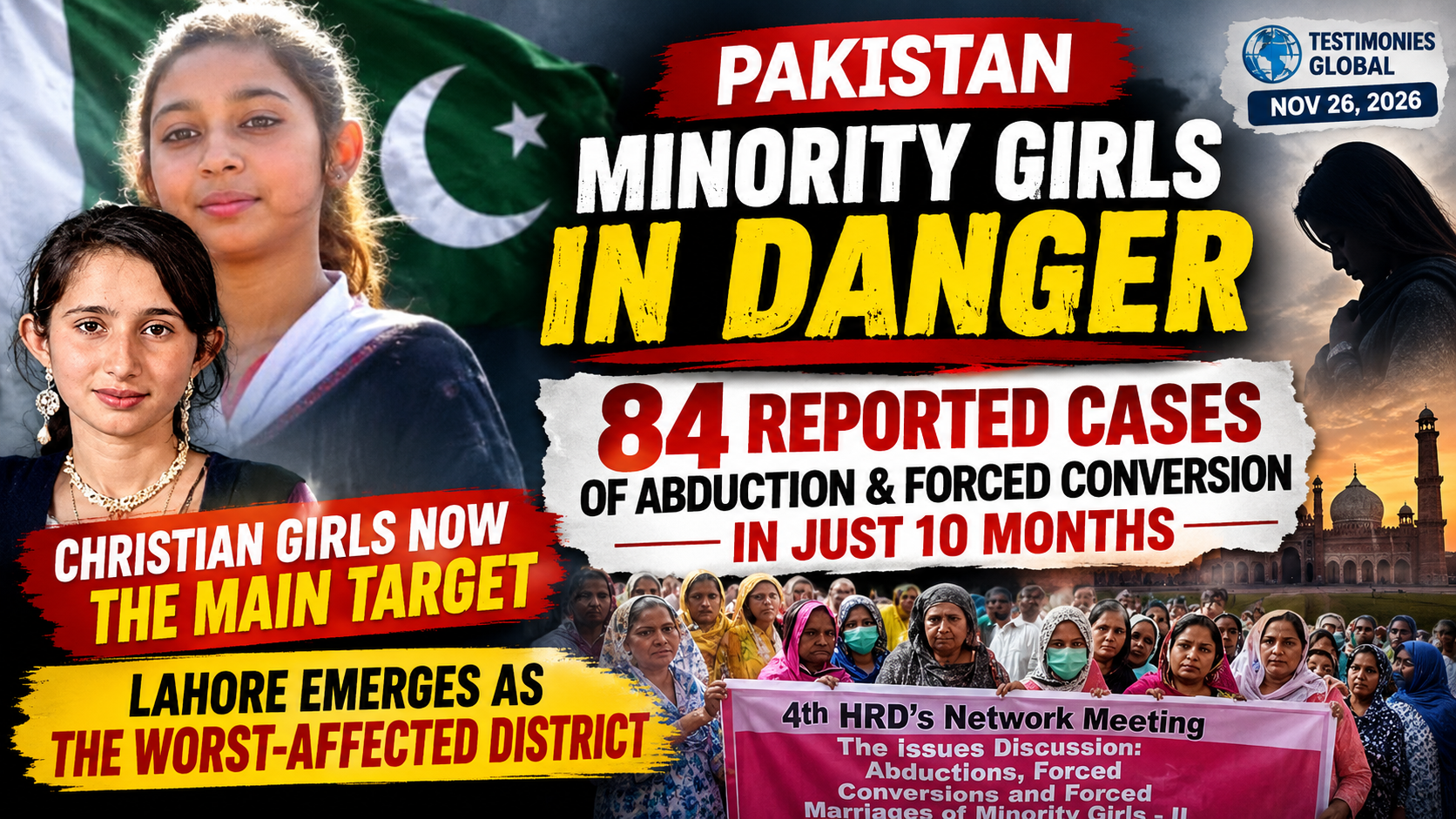
A new report by Pakistan’s Centre for Social Justice (CSJ) has documented 84 cases of abduction and alleged forced religious conversion involving girls and women from religious minorities during the first ten months of 2026, highlighting a significant shift in the geographical pattern of the reported cases.
According to the Lahore-based human rights organization, Christians accounted for the majority of victims in Punjab, while Hindu girls and women remained the principal victims in Sindh. Lahore recorded the highest number of cases among all districts.
The findings were published on November 3 in an update titled “The Persisting Issue of Forced Conversions of Christian and Hindu Girls.” The report was subsequently covered by Pakistani outlet Voicepk and Christian Daily International–Morning Star News.
84 cases reported in ten months
The CSJ documented 49 Christian and 35 Hindu victims between January and October 2026.
Of the reported cases, 47 occurred in Punjab, 36 in Sindh, and one in Balochistan. The religious composition of the victims closely reflected the provincial distribution: 46 of the 47 victims reported in Punjab were Christian, while 33 of the 36 cases in Sindh involved Hindu girls or women.
The report also raised concerns about the ages of the victims.
Thirty-seven victims, representing approximately 44 percent of the total, were between 14 and 17 years old. Six were younger than 14. At least 43 victims were therefore under the age of 18, while the ages of another ten could not be confirmed.
The figures indicate that children account for more than half of the cases in which ages have been established, although the actual proportion may be higher.
Pakistan ratified the United Nations Convention on the Rights of the Child in 1990, committing itself to protecting children from exploitation and safeguarding their rights.
Punjab records sharp increase
The latest figures mark a notable change from the pattern recorded by the CSJ between 2021 and 2025.
During those five years, the organization documented 515 cases of alleged abduction and forced conversion. The annual figures were 78 in 2021, 124 in 2022, 136 in 2023, 83 in 2024, and 94 in 2025.
Sindh accounted for 363 cases during the five-year period, representing approximately 70 percent of the total. Punjab recorded 146 cases, while four were reported in Balochistan and two in Khyber Pakhtunkhwa.
However, the latest data show Punjab emerging as the leading province for reported cases.
With 47 cases in just ten months, Punjab has already recorded nearly one-third of the total cases documented there over the previous five years.
Lahore topped the district-level figures, with 18 reported cases. The city had recorded 39 cases throughout the entire 2021–2025 period. Faisalabad followed with six cases.
In Sindh, Sanghar recorded seven cases, Tando Allahyar five, and Hyderabad and Mirpur Khas four each.
If the current pace continues through the end of the year, the total for 2026 could approach or exceed 100 cases, surpassing the 94 documented in 2025.
Christian girls increasingly affected
The report also points to a change in the religious composition of the victims.
According to figures cited by Christian Solidarity Worldwide (CSW), based on CSJ data, 71 of the 94 victims recorded in 2025 were Hindu, while 23 were Christian.
In contrast, the 49 Christian victims documented during the first ten months of 2026 already represent more than twice the number recorded throughout the previous year.
The CSJ cautions that its figures reflect only cases that were reported and independently verified. The data may be revised as further information becomes available.
The organization also warns that a decline in reported cases in Sindh should not necessarily be interpreted as a reduction in incidents. Vulnerable Hindu families, particularly those from economically disadvantaged and marginalized communities, may be reluctant to approach police or courts because of fear, social pressure, or a lack of confidence in the justice system.
Maria Shahbaz case raises concerns over child marriage
The CSJ report highlights the case of Maria Shahbaz, a Christian girl from Lahore whose family alleges that she was abducted, converted to Islam, and married against her will.
According to her family and documents presented in court, Maria was 13 years old when she was abducted in July 2025. She was allegedly converted and married to a 30-year-old Muslim man.
Earlier this year, the Federal Constitutional Court upheld the marriage, prompting concerns among rights advocates about the protection of minors in cases involving alleged forced conversion and marriage.
In July, a two-judge bench of the same court admitted a review petition filed by Maria’s father. A larger bench has since begun hearing the matter.
The CSJ has expressed concern about the time required for the legal proceedings, warning that prolonged cases can leave alleged victims in vulnerable situations and undermine efforts to protect children from exploitation.
The case has also raised broader questions about whether marriage documents are being used to complicate or halt investigations into alleged abductions.
 Maria Shahbaz
Hindu woman’s case highlights concerns over exploitation
Another case cited in the report involves Rita, a 21-year-old Hindu woman from Sanghar District in Sindh.
According to the CSJ, Rita was allegedly drawn into a relationship with a man from Gujranwala, Punjab, who persuaded her to convert to Islam.
In August, a judicial magistrate rejected a police request to transfer her to a shelter and ordered that she be returned to her family.
The CSJ noted that the man had allegedly previously converted and married a Christian woman, raising concerns about possible patterns of exploitation.
The allegations have not been independently established in the report.
Concerns over two Hindu girls
The CSJ has also raised concerns about the cases of two Hindu girls: 14-year-old Bindiya Kumari from Sibi, Balochistan, and Kalpana Meghwar from Umerkot, Sindh, whose school records reportedly indicate that she is 13.
Both girls were reportedly converted at the Bharchundi Sharif shrine in Ghotki District, Sindh.
The report refers to the involvement of Pir Abdul Haq, commonly known as Mian Mithu, a cleric and politician whose name has appeared in previous controversies involving alleged forced conversions.
Mian Mithu has denied that the conversions conducted under his supervision are forced.
The case of Bindiya Kumari remains the subject of legal and political proceedings. The CSJ has expressed concern about the girls’ whereabouts, their families’ access to them, and their legal status.
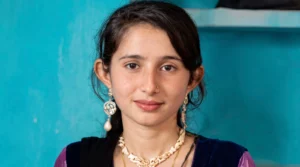 Bindiya Kumari
Human rights bodies call for stronger protections
The CSJ has criticized the response of law enforcement and judicial institutions, describing investigations and court proceedings in such cases as frequently slow.
Pakistan’s National Commission for Human Rights, National Commission on the Rights of the Child, and National Commission on the Status of Women have repeatedly raised concerns about forced conversions and the protection of minority girls.
However, the CSJ says preventive and protective measures have been delayed.
The organization has urged Parliament to consider legislation regulating religious conversions and strengthening safeguards for vulnerable individuals.
A draft bill was submitted to the Ministry of Human Rights in October by the National Commission on the Rights of the Child following consultations with the CSJ.
The organization has also called for administrative measures to identify and prosecute those accused of exploiting minority girls, as well as public awareness campaigns to address the issue.
Previous legislative efforts stalled
Pakistan has previously attempted to introduce legislation against forced conversions.
In 2016, the Sindh Assembly passed a bill aimed at preventing forced religious conversions. However, the legislation failed to become law following opposition and protests by religious groups.
In 2021, a federal bill was rejected by a parliamentary committee after objections from the Ministry of Religious Affairs.
The latest draft has emerged from a state institution, potentially giving it greater legitimacy within Pakistan’s legislative framework. However, its prospects remain uncertain amid continued opposition from religious groups that argue conversions to Islam should be presumed voluntary.
International attention has yet to bring lasting change
The issue of minority rights in Pakistan has also drawn attention beyond the country.
Earlier this month, concerns about the situation of Pakistan’s Hindu community were raised in the British Parliament, adding to international scrutiny of the treatment of religious minorities.
Human rights advocates say international attention is important, particularly when domestic institutions fail to provide adequate protection.
However, the CSJ’s latest figures suggest that statements of concern have not yet translated into a substantial reduction in reported cases.
Behind the statistics are girls and women whose families allege that they were abducted, converted, and married against their will.
The 84 cases documented during the first ten months of 2026 represent only those incidents that were reported and could be verified.
The number of cases that remain unreported is unknown.