By Riteeka Rani
Community Lead, Human Rights & Welfare International
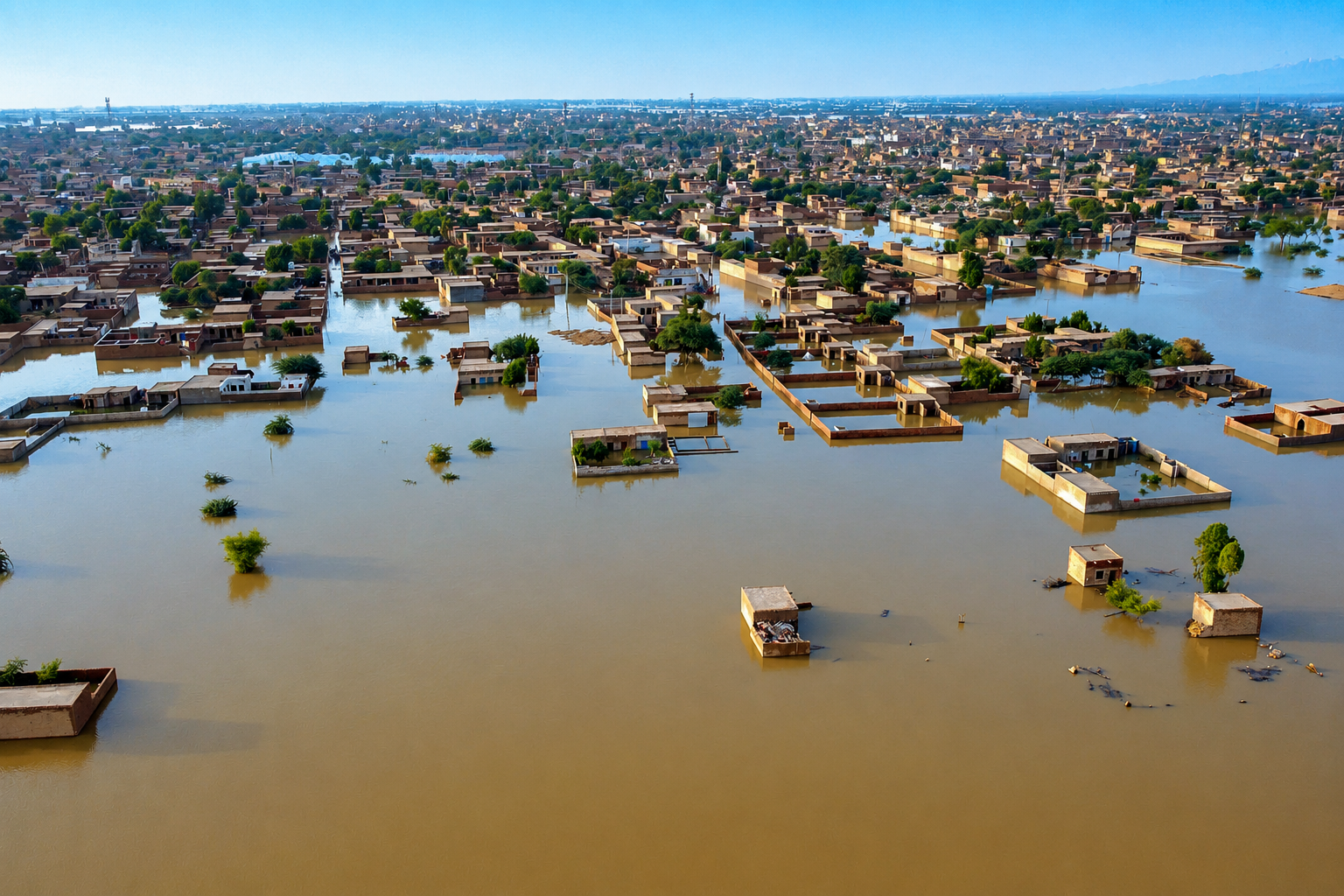
In September 2022, I stood at a flood relief camp in Umerkot, Sindh, watching families who had lost everything — their homes, their crops, their livestock — sitting on roadsides in makeshift tents. The water had swallowed entire villages. Children were crying. Women had nowhere to use the toilet. And the world was watching Pakistan from a distance, offering sympathy but little urgency.
That experience changed how I understand climate change. Not as an abstract global phenomenon argued over in conference halls, but as a daily, brutal reality playing out in the villages of Sindh — and falling hardest on those who did nothing to cause it.
The Flood That Wasn’t a Surprise
The 2022 Sindh floods were catastrophic by any measure. One-third of Pakistan was submerged. Over 1,700 people died. More than 33 million were displaced. In Sindh alone, entire districts vanished under water for months.
But here is what the international headlines missed: for the most vulnerable communities of Sindh — rural Hindu minorities, bonded laborers, Dalit families, women and girls — the disaster was not just a natural catastrophe. It was the violent convergence of decades of neglect and accelerating climate breakdown.
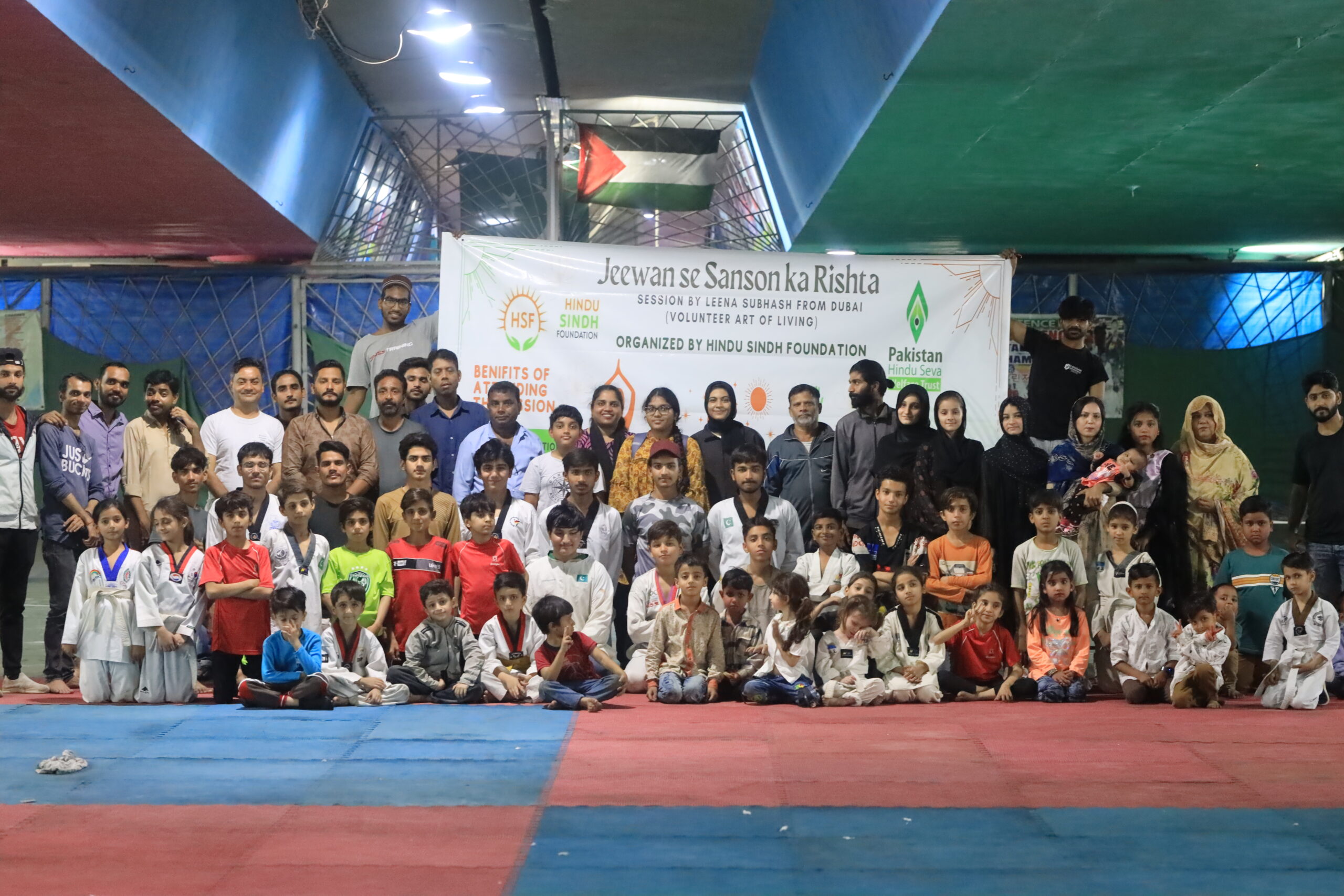
As part of the Hindu Sindh Foundation’s relief operations, I witnessed firsthand what that convergence looks like. Families who had no land title could not access government relief schemes. Women in flood shelters faced severe sanitation crises because no one had planned toilets for them. Minority communities, already living on the margins, had no political voice to demand help. The flood did not discriminate, but the relief did.
Scientists have been clear: South Asia’s monsoon patterns are being disrupted by climate change. Pakistan contributes less than one percent of global greenhouse gas emissions, yet bears a disproportionate burden of climate consequences. Sindh — flat, low-lying, dependent on the Indus — is among the most exposed regions on earth.
The Desert That Is Drying Further
Drive southeast from Hyderabad toward the Indian border and you reach Tharparkar — one of the most climate-vulnerable landscapes in Asia. Thar is a desert, yes, but it was once a desert that could sustain life through seasonal rains, wells, and centuries of adaptation. Communities there had learned to live with scarcity.
Climate change has broken that adaptation.
In April 2026, my reporting documented a devastating health crisis in Tharparkar: 50 infant deaths in a single month. Behind that number is a story of failed monsoons, dried wells, malnourished mothers, and children born into a landscape that can no longer feed them. Hospitals are understaffed. Roads are broken. And the communities most affected — largely Hindu Dalit and Meghwar families — remain invisible to national climate policy conversations.
Tharparkar is not suffering a drought. It is suffering a climate emergency in slow motion. The rains that once arrived have become unreliable. The groundwater that sustained communities is depleting. The heat is intensifying. And in this desert, where survival has always required precision and community knowledge, the margin for error is now almost gone.
The Heat That Kills Quietly
Sindh regularly records some of the highest temperatures on earth. Jacobabad, a city in upper Sindh, has repeatedly exceeded the theoretical limit of human survivability — the point at which the body can no longer cool itself even in the shade. In 2022, it briefly hit 51°C.
These are not outliers. They are trends.
For the urban poor of Karachi, for the agricultural laborers in interior Sindh, for the elderly women in villages without electricity, heat is not a news story. It is a cause of death that goes unrecorded. People collapse in fields. Infants overheat. Livestock die. Crops fail. And the families most dependent on outdoor labor — who have no air conditioning, no leave policy, no savings — absorb the loss silently.
In my community work across Sindh, I have seen how climate stress compounds every other vulnerability. A farmer who loses his crop to a heatwave cannot repay the landlord. A family that flees the flood arrives in the city with nothing. A girl pulled out of school to fetch water further from home because the well dried up will not return. Climate change is not a single disaster. It is a multiplier of all existing injustices.
What COP Must Hear From Sindh
Every year, the world’s governments gather at the UN Climate Conference — COP — to negotiate emissions targets, climate finance, and adaptation frameworks. These negotiations matter. The decisions made in those rooms will determine whether communities like those in Tharparkar and Umerkot survive the coming decades.
But the voices of those communities are almost never in those rooms.
Pakistan’s frontline communities — minority groups, bonded laborers, women in flood camps, children dying in desert hospitals — are rarely represented in climate diplomacy. Their stories, their knowledge, their survival strategies are absent from the documents that shape global policy.
This is the gap that must be closed. Not through charity, but through representation. Journalists from the Global South, reporters who have stood in flood camps and sat with grieving mothers in Tharparkar, must be part of the conversation at COP. The data matters. But the human story behind the data is what creates political will.
A Personal Commitment
I have spent the last several years documenting the lives of Sindh’s most marginalized communities — through Sindh Renaissance, through HRWI, through on-the-ground relief work with the Hindu Sindh Foundation. That work has taught me that climate change is not a future threat. It is happening now, here, to people I know by name.
At COP31, I want to carry those names into the room. I want to report on how the agreements being signed will — or will not — reach the women in the flood shelters, the infants in Tharparkar, the farmers watching their fields crack under the sun.
Sindh is not waiting for the world to notice. But it needs journalists willing to make sure the world cannot look away.