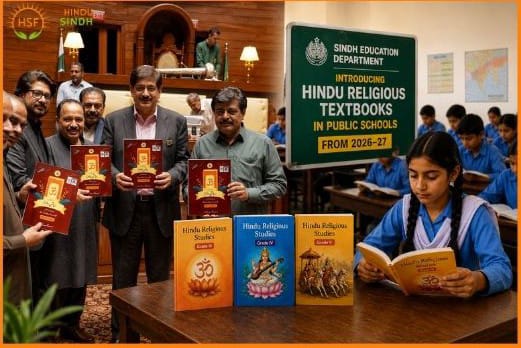
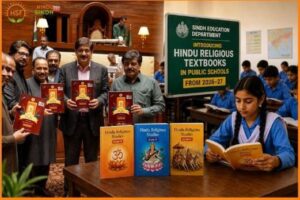
Karachi | June 2026: In a landmark step toward promoting religious inclusion and equal educational opportunities, the Government of Sindh has officially launched the first batch of Hindu Religious Education textbooks for Grades III to V for students enrolled in government schools across the province.
The textbooks were formally unveiled during a ceremony held at the Sindh Assembly on Sunday, June 28, 2026. The event was attended by Sindh Chief Minister Syed Murad Ali Shah, Education Minister Syed Sardar Ali Shah, Excise, Taxation and Narcotics Control Minister Mukesh Kumar Chawla, Special Assistant to the Chief Minister on Minority Affairs Dr. Shyam Sundar Advani, and Member of the Provincial Assembly Mahesh Kumar Hasija, along with education officials, community representatives, and stakeholders.
The initiative marks the implementation of Article 22(1) of the Constitution of Pakistan, which guarantees that no student shall be required to receive religious instruction relating to a faith other than their own. With the introduction of these textbooks, Hindu students studying in Sindh’s public schools will now have access to religious education based on their own beliefs, replacing the long-standing gap in the provincial curriculum.
The Sindh School Education and Literacy Department had earlier approved the publication of three Hindu Religious Education textbooks for the 2026–27 academic session following recommendations by the Executive Committee of the Sindh Curriculum Council. According to official documents, the textbooks will initially cover students from Grades III, IV and V, while the Sindh Textbook Board will oversee their distribution across the province. For the current academic year, publication costs are being supported by the Karachi-based welfare organization Prem Sagar Sanstha, with the provincial government expected to allocate regular funding in future budgets.
Education officials have described the initiative as a significant advancement in ensuring constitutional rights, religious freedom, and educational equality for minority communities. Reports indicate that more than 129,000 Hindu students are enrolled in government schools across Sindh, with the highest numbers in districts including Tharparkar and Umerkot.
The launch follows years of advocacy, consultations, and continuous engagement between minority representatives, education experts, civil society organizations, and the Sindh Education Department. Stakeholders have welcomed the development as an important milestone in strengthening inclusive education and promoting interfaith harmony within Pakistan’s education system.
While celebrating the achievement, education experts and community leaders have emphasized that successful implementation will depend on the timely printing and distribution of textbooks, appointment of qualified teachers, and effective classroom delivery to ensure Hindu students across Sindh fully benefit from the initiative.
Community representatives also expressed appreciation to the Government of Sindh, particularly Chief Minister Syed Murad Ali Shah, Education Minister Syed Sardar Ali Shah, Special Assistant on Minority Affairs Dr. Shyam Sundar Advani, and all officials and stakeholders whose efforts contributed to making the project a reality.
Observers believe the introduction of Hindu Religious Education into the provincial curriculum reflects Sindh’s longstanding traditions of religious tolerance, coexistence, and mutual respect. Many have expressed hope that similar measures will continue to strengthen educational inclusion and safeguard the constitutional rights of all minority communities across Pakistan.
The initiative is being widely viewed as an important step toward ensuring that every student receives education in accordance with their own faith while reinforcing the principles of equality and diversity enshrined in Pakistan’s Constitution.
For more updates and detailed coverage of this case and other issues affecting the Hindu and Sindhi communities in Sindh, Pakistan, stay tuned to Sindh Renaissance.