MIRPURKHAS, Sindh🇵🇰- Ten members of two Hindu families from Sindh reportedly embraced Islam at a religious ceremony in Mirpurkhas on Saturday, September 12, 2026, in an event that has drawn attention to the complex social, economic and religious circumstances facing vulnerable minority communities in parts of rural Sindh.
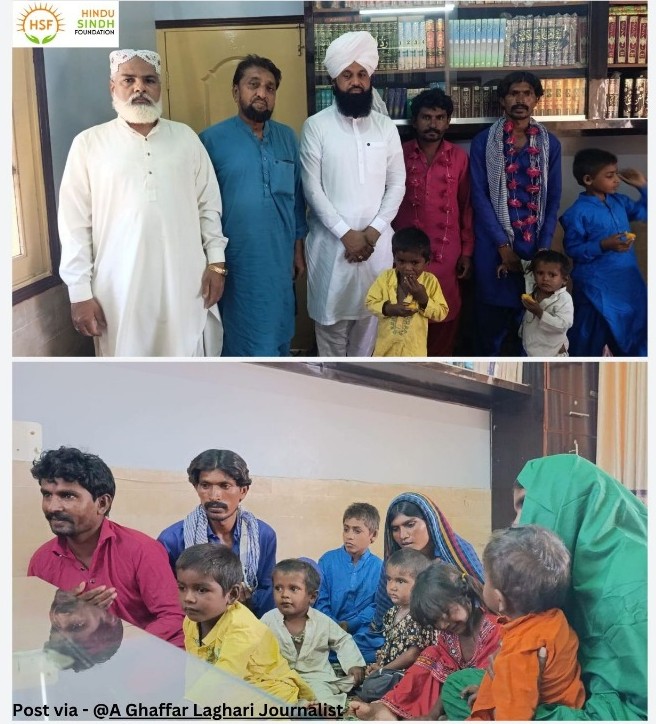
According to details of the ceremony, the families recited the Kalima Tayyiba at Jamia Noor-ul-Quran, Mirpurkhas, in the presence of Hazrat Allama Mufti Muhammad Sharif Saeedi Ashrafi and other attendees.
From the first family, the head of the household, identified as Noonai, son of Nathu Bheel, adopted the name Noor Muhammad. His wife adopted the name Samina Bibi, while their children took the names Qadir Bakhsh, Fatima, Faiza and Nahid.
From the second family, the head of the household, identified as Wapari, son of Aroo Bheel, adopted the name Ghulam Rasool. His wife adopted the name Saeeda Bibi, while their children took the names Muhammad Fazal and Muhammad Majid.
The ceremony was also attended by Muhammad Javed, Muhammad Azam Khan Brohi and Muhammad Mudassir Mughal, among others. The newly converted families were reportedly garlanded and congratulated by those present.
The circumstances surrounding the families’ decision to convert were not independently established in publicly available sources, and it would be inappropriate to characterize the conversion as forced without evidence from the families themselves, police, courts or other competent authorities.
A vulnerable minority community
The reported ceremony comes against a wider backdrop of social and economic vulnerability among sections of Sindh’s Hindu population.
Pakistan’s 2023 census recorded more than 3.57 million people identifying as Hindu Jati in Sindh, in addition to about 1.33 million people recorded as belonging to Scheduled Castes. The Hindu population is particularly concentrated in rural areas: the census recorded about 2.49 million Hindu Jati people and 1.15 million Scheduled Castes residents in rural Sindh.
Human Rights Commission of Pakistan (HRCP) research has linked the difficulties faced by sections of the Hindu community to a combination of factors, including insecurity, faith-based violence, economic hardship and climate-related pressures.
In January 2025, HRCP released its fact-finding study “Exodus: Is the Hindu Community Leaving Sindh?”. The organization said Hindu families had been leaving Sindh because of insecurity, religious discrimination and violence, as well as economic difficulties and climate change. The study specifically highlighted the vulnerability of Hindu women and girls to abduction, forced conversion and underage marriage.
These problems are not confined to a single district. The Sindh Human Rights Commission has investigated allegations involving Hindu minors in several parts of the province. In June 2025, for example, the commission said its chairperson had sought information from district authorities concerning the alleged forced conversion of three minor girls and a teenage boy from a Hindu family in the Shahdadpur area of Sanghar district.
Forced conversion remains a serious concern
The distinction between voluntary conversion and forced conversion is crucial.
Pakistan’s Constitution provides citizens with the right to profess, practise and propagate their religion, while the state is also constitutionally committed to safeguarding the legitimate interests of minorities.
At the same time, international and Pakistani rights organizations have repeatedly documented allegations involving the abduction, forced conversion and marriage of Hindu and Christian girls.
A 2026 assessment by the U.S. Commission on International Religious Freedom (USCIRF) said reports of forced conversions among Hindu and Christian girls in Sindh and Punjab continued during 2025. It cited, among other cases, an alleged abduction and forced conversion involving a 15-year-old Hindu girl in Matli, Sindh.
UN human-rights experts went further in April 2026, warning of continuing patterns of abduction and forced religious conversion through marriage affecting minority women and girls in Pakistan. According to the experts, approximately 75 percent of reported women and girls affected by forced conversion through marriage in 2025 were Hindu, while about 80 percent of the incidents occurred in Sindh. They said girls between 14 and 18 were particularly vulnerable, although younger children were also affected.
The findings are particularly significant because poverty and marginalization can make vulnerable families less able to obtain legal assistance, pursue complaints or protect children from exploitation.
The law already prohibits child marriage in Sindh
Sindh has legislation specifically intended to prevent child marriage.
Under the Sindh Child Marriages Restraint Act, 2013, a “child” is defined as a person under 18 years of age, and a marriage involving a child is classified as a child marriage. The law provides criminal penalties for those involved in such marriages.
The existence of legislation, however, does not automatically guarantee protection.
Recent court proceedings demonstrate both the problem and the possibility of legal intervention. In February 2026, a court in Thatta declared the marriage of a 16-year-old Hindu girl void, holding that a minor’s purported consent could not override the statutory prohibition on child marriage. The girl was ordered to be placed in protective custody.
HRCP has similarly criticized the continuing gap between legal protections and their implementation, pointing to persistent forced conversions and underage marriages involving Hindu and Christian girls in Sindh and Punjab.
Poverty, education and insecurity
The challenges confronting marginalized rural communities cannot be reduced to religion alone.
Economic insecurity, limited educational opportunities, poor access to public services and weak access to justice can compound the vulnerability of families living in remote parts of Sindh.
HRCP’s 2025 research described the reasons behind Hindu migration from Sindh as interconnected: faith-based insecurity exists alongside economic struggles and climate-related pressures.
For communities living in isolated settlements, the ability to report a crime, obtain legal representation or challenge powerful individuals can be considerably more difficult than it is for families living in urban centres.
This makes the protection of minority rights not simply a question of religious freedom but also one of access to education, employment, policing, justice and basic citizenship rights.
A ceremony that raises broader questions
The Mirpurkhas ceremony itself should not automatically be presented as evidence of coercion. A person has a constitutional right to change or profess a religion, and a conversion should not be described as forced unless credible evidence establishes coercion.
But the broader environment in which such conversions occur deserves scrutiny.
Where poverty, lack of education, insecurity or alleged violence are present, authorities have a responsibility to ensure that every conversion—particularly one involving children- is genuinely voluntary and free from intimidation, abduction, exploitation or pressure.
The challenge for Pakistan’s institutions is therefore twofold: protect the right of adults to freely choose their religion while ensuring that vulnerable minorities, especially women and children, are protected from coercion and abuse.
For the families who reportedly embraced Islam in Mirpurkhas on September 12, the immediate story is one of a religious ceremony and a change of names and faith. The larger story is about whether people living in some of Sindh’s poorest and most isolated communities can exercise their rights freely- regardless of which religion they follow.
As Sindh continues to grapple with allegations of forced conversions, child marriage, economic deprivation and minority insecurity, effective enforcement of existing laws may ultimately matter more than the number of laws on the books.
For more updates and detailed coverage of this case and other issues affecting the Hindu and Sindhi communities in Sindh, Pakistan, stay tuned to Sindh Renaissance.