
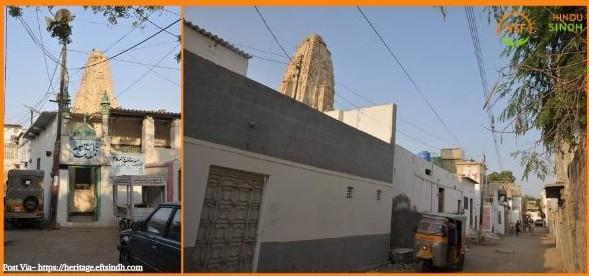
KARACHI Sindh🇵🇰: Hidden within the densely populated neighborhoods of Shah Faisal Town near Malir stands a little-known relic of Karachi’s diverse religious heritage- the historic Malir Hanuman Temple, commonly known among locals as the Malir Mandir. Once a significant place of worship and community gathering for the area’s Hindu residents, the temple has remained closed for decades and today survives largely in obscurity amid rapid urban expansion and neglect.
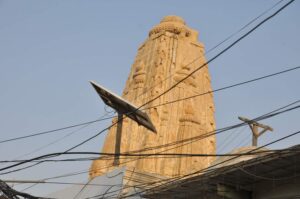
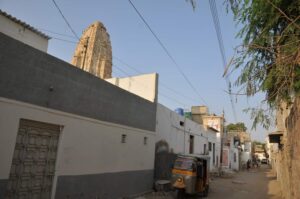
Rising above surrounding buildings, the temple’s distinctive spire (shikhara) remains visible from parts of the neighborhood, serving as one of the few remaining indicators of the site’s historical significance. Narrow lanes leading into the old compound reveal traces of a structure that once played an important role in the religious and social life of Karachi’s Hindu community.
According to heritage records and local accounts, the temple has reportedly remained sealed since the early 1990s. Residents claim the site was locked following the demolition of the Babri Masjid in India in 1992 and has largely remained inaccessible ever since. Over the years, the structure has gradually faded from public attention, overshadowed by surrounding residential and commercial development.
A Historic Religious Complex
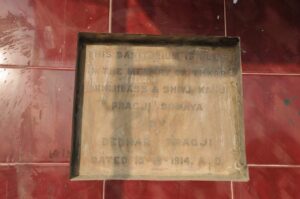
Historical documentation suggests that the temple was associated with a larger compound that included a sanatorium established in 1914. Researchers believe that a Shiv Mandir existed on the site even before the sanatorium’s construction, indicating that the area had long served as a religious center for local Hindus.
The neighborhood itself still preserves memories of the temple’s presence. The nearby transport stop continues to be popularly known as “Malir Mandir,” reflecting the landmark’s former prominence within the community.
For decades, the temple complex functioned as a religious and cultural gathering point where festivals, rituals, and community activities were held. However, demographic shifts, migration, encroachments, and a lack of conservation efforts contributed to its gradual decline.
Concerns Over Preservation
Residents and heritage activists have repeatedly voiced concerns regarding unauthorized construction and commercial activities around the compound. They argue that encroachments have threatened what remains of the historical structure and have further obscured its architectural features.
Visitors attempting to locate the temple today often encounter only fragments of the original complex. Local accounts describe the site as closed, partially demolished, or adapted for residential purposes, with little visible evidence of its former status as a place of worship.
Heritage experts regard the Malir temple as an important symbol of Karachi’s pluralistic history. The structure represents an era when diverse religious communities lived, worked, and worshipped across the city, contributing to Karachi’s rich cultural identity.
Distinction from Karachi’s Active Hanuman Temple
The Malir Hanuman Temple is often confused with Karachi’s most prominent Hanuman shrine, the Shri Panchmukhi Hanuman Mandir in Soldier Bazaar. However, the two sites are distinct.
The Panchmukhi Hanuman Mandir remains an active place of worship and is recognized as a protected heritage site. Believed by devotees to be among the oldest Hanuman temples in the world, it continues to attract worshippers during Hanuman Jayanti, Diwali, Holi, and other religious festivals.
In contrast, the Malir temple stands largely abandoned, its future uncertain and its historical significance increasingly overlooked.
A Question for Karachi’s Future
Conservation advocates argue that despite its deteriorated condition, the Malir Hanuman Temple deserves proper documentation, legal protection, and restoration as part of Sindh’s cultural heritage. They believe preserving such sites is essential not only for protecting architecture but also for safeguarding the historical memory of communities that helped shape Karachi.
As the city continues to expand and modernize, the fate of the Malir Hanuman Temple raises a broader question: can Karachi preserve its diverse cultural heritage before more historic landmarks disappear from the urban landscape?
For now, the aging shikhara rising above Malir’s crowded streets remains a silent reminder of a chapter of Karachi’s history that many fear may soon be forgotten.
For more updates and detailed coverage of this case and other issues affecting the Hindu and Sindhi communities in Sindh, Pakistan, stay tuned to Sindh Renaissance.