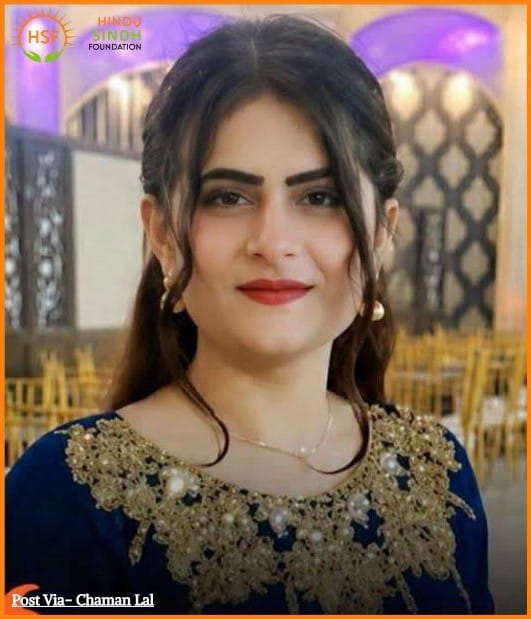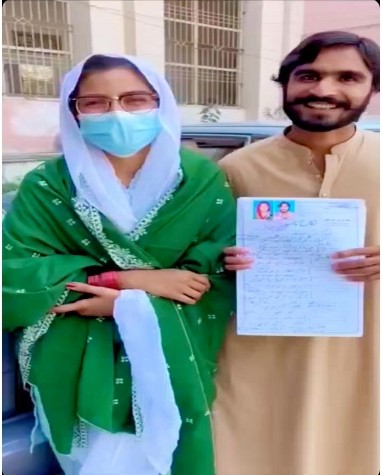
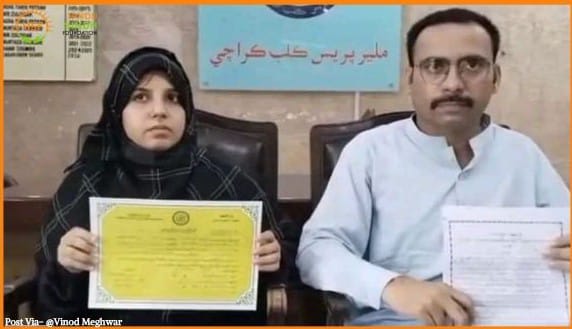
Karachi🇵🇰: Reports circulating on social media and in sections of the local media have claimed that Samrin Talreja, a Hindu resident of Shikarpur, Sindh, has embraced Islam, adopted the name Amina, and subsequently married Nabi Rehman Patafi, reportedly from Ghotki.
According to these reports, the marriage was solemnized in Karachi’s Malir Court and was presented as having taken place with the mutual consent of both parties. As of publication, no official statement from the Sindh government, police, or the court has been publicly released confirming the details of the case, and the reported conversion and marriage have not been independently verified.
The reported incident has once again drawn attention to the long-standing debate over alleged forced conversions and marriages involving members of Pakistan’s Hindu minority, particularly in Sindh.
Human rights organizations and minority rights advocates have for years expressed concerns over cases in which Hindu or Christian girls are reported missing, followed by announcements of religious conversion and marriage. In many such cases, families have alleged coercion or abduction, while the women involved have stated before courts that they converted and married voluntarily. These differing accounts have made independent judicial scrutiny essential in determining the facts of each individual case.
Members of the Hindu community have called on the relevant authorities to conduct a transparent and impartial investigation into the reported case. They have urged officials to verify the woman’s age, ensure that any religious conversion or marriage occurred without coercion, and confirm that her statement was made freely before a competent court.
Legal experts note that Pakistani law requires courts to determine whether an individual’s consent has been given voluntarily, particularly where allegations of abduction, forced conversion, or forced marriage are raised. Human rights groups have repeatedly emphasized that every case should be examined independently rather than treated as part of a broader narrative.
The issue of conversions involving minority women has remained a sensitive subject in Pakistan for several years. Various national and international human rights organizations have documented concerns regarding alleged forced conversions, while courts have stressed the importance of evaluating evidence on a case-by-case basis.
Community representatives say that transparency, due process, and the protection of constitutional rights are essential to maintaining public confidence in the justice system. They have called on authorities to ensure that all parties are heard fairly and that any investigation is conducted in accordance with Pakistani law.
The developments surrounding the reported case of Samrin Talreja remain subject to official verification. If authorities issue statements or court documents become publicly available, this story will be updated accordingly.
For more updates and detailed coverage of this case and other issues affecting the Hindu and Sindhi communities in Sindh, Pakistan, stay tuned to Sindh Renaissance.