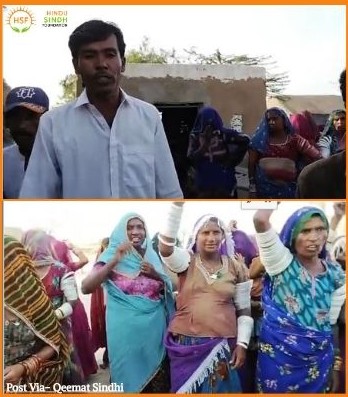
UMERKOT, Sindh🇵🇰: Residents of Bheens Colony, located in Union Council Garibabad, Ward No. 314 of Umerkot district, have appealed to the Sindh government and district administration for immediate intervention, saying nearly 800 families have been deprived of essential public services for the past 13 years.
According to local residents, the settlement is home to around 800 families, including approximately 500 Hindu and 300 Muslim families, who say they continue to live without a paved access road, a clean drinking water supply, or a nearby basic health facility.
The residents describe the situation as a humanitarian issue rather than a political one, emphasizing that both communities face the same hardships.
Ambulance Access a Major Concern
Villagers claim that the absence of a proper road has repeatedly delayed emergency medical care. They allege that ambulances are unable to enter the area, particularly during the monsoon season, forcing families to carry sick patients, pregnant women, elderly residents and children for nearly four kilometres to reach the nearest accessible road.
Residents further claim that several patients have lost their lives over the years because emergency medical assistance could not reach the village in time. These claims could not be independently verified.
Development Schemes Allegedly Out of Reach
According to community members, the lack of road infrastructure has also prevented several government welfare and development initiatives from effectively reaching the locality.
Residents say the poor accessibility has affected surveys conducted under the National Socio-Economic Registry (NSER), while also limiting access to programmes such as the Benazir Income Support Programme (BISP), public health services and other provincial and federal development schemes.
The NSER serves as the primary database used to identify low-income households for various social protection programmes in Pakistan, including BISP. Accessibility and field surveys are considered important for ensuring eligible families are included.
Constitutional Rights
Community leaders argue that access to roads, clean drinking water and basic healthcare should not be viewed as charity but as constitutional rights guaranteed to every citizen.
They referred to Article 9 of the Constitution of Pakistan, which guarantees the right to life and liberty, and Article 38, which directs the State to promote the social and economic well-being of citizens by ensuring access to basic necessities and reducing inequalities.
Residents Demand Immediate Action
The residents have called upon the Government of Sindh, the Deputy Commissioner Umerkot, local elected representatives and relevant government departments to:
- Construct a paved road connecting Bheens Colony to the main road.
- Ensure a permanent supply of safe drinking water.
- Establish a Basic Health Unit (BHU) or nearby healthcare facility.
- Extend government welfare and development programmes to all eligible families in the settlement.
“Our demand is simple,” residents said. “We are asking for our constitutional rights- not charity.”
At the time of publication, no official response from the district administration or the Government of Sindh regarding the residents’ allegations had been issued.
For more updates and detailed coverage of this case and other issues affecting the Hindu and Sindhi communities in Sindh, Pakistan, stay tuned to Sindh Renaissance.