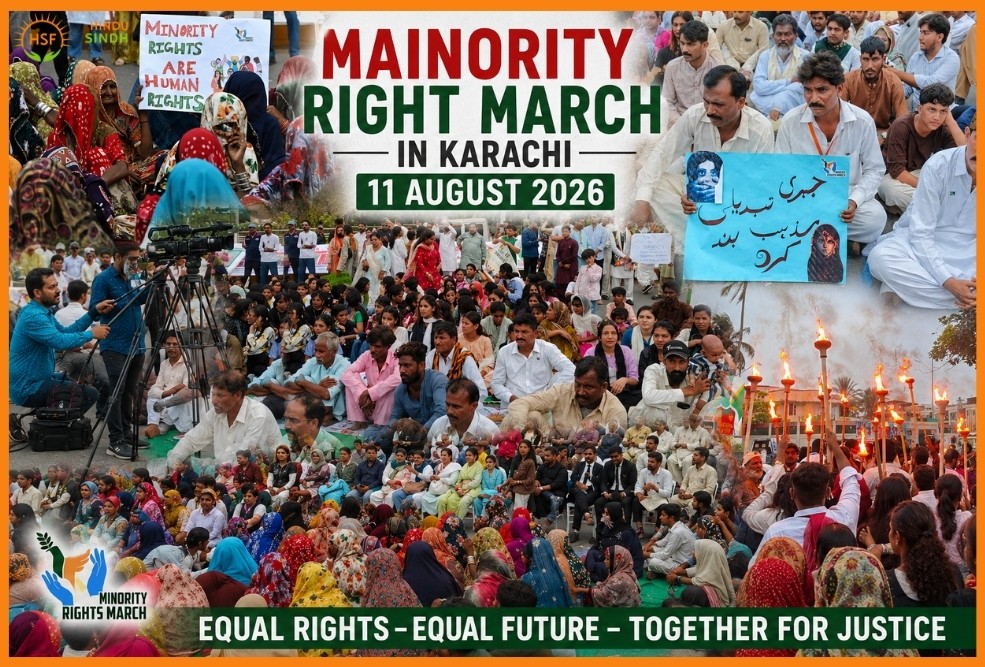
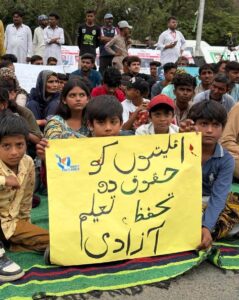
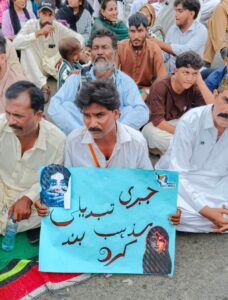
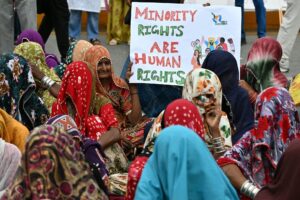
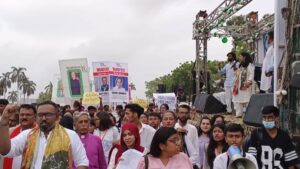
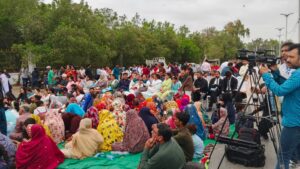
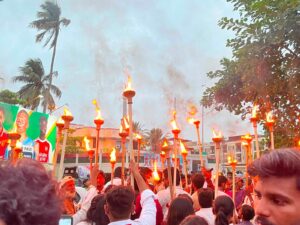
Religious minority communities and civil society activists gathered in Karachi on August 11 for the Minority Rights March 2026, marking Pakistan’s National Minorities Day with renewed calls for equality, religious freedom, protection from discrimination and stronger political representation.
The march, held under the theme “Will Be Remembered,” brought together representatives and supporters of Pakistan’s religious minority communities.
The Hindu Sindh Foundation also participated in the event, according to information provided by the organisation and participants.
The marchers called for the protection of fundamental rights guaranteed to every Pakistani citizen and demanded effective measures against discrimination, forced conversions, misuse of religious laws and the marginalisation of minority communities.
Participants also called for equal and empowered representation of religious minorities in political and state institutions, arguing that minorities should enjoy full civil and political rights as equal citizens of Pakistan.
Why August 11 matters
Pakistan observes National Minorities Day on August 11, a date associated with Quaid-e-Azam Muhammad Ali Jinnah’s historic address to the Constituent Assembly on August 11, 1947.
In the speech, Jinnah said citizens were free to go to their temples, mosques or other places of worship and declared that religion, caste and creed should have no connection with the affairs of the state.
The speech has become an important reference point for Pakistan’s minority-rights movement and for campaigns demanding equality before the law.
The federal government formally declared August 11 as National Minorities Day in 2009, with the stated objective of highlighting the religious, social and economic rights of minority communities and reaffirming the protection of their fundamental freedoms.
Sindh Chief Minister Syed Murad Ali Shah has similarly described August 11 as a reminder of Jinnah’s vision of equal rights, recalling the founder’s assurance that citizens of all faiths would have freedom to worship.
‘Will Be Remembered’- a message of equality
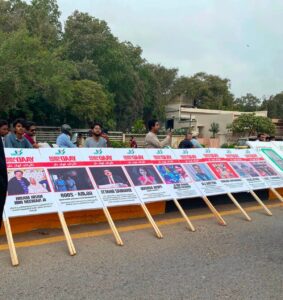
The 2026 march’s theme, “Will Be Remembered,” reflects the wider tradition of minority-rights activism in Pakistan, where participants have invoked victims of religious discrimination and violence while demanding accountability and legal protection.
The movement has historically included Christians, Hindus, Sikhs, Parsis and members of other religious communities, as well as human-rights activists, women’s organisations and civil-society groups.
Previous Minority Rights Marches in Karachi have used public demonstrations to draw attention to forced conversions, discrimination in education and employment, protection of religious places, misuse of blasphemy laws and political representation.
Eleven demands for minority rights
Participants in the 2026 march presented 11 demands concerning the rights and protection of religious minorities.
The demands focused broadly on:
- Equal citizenship and civil rights for members of all religious communities.
- Equal and meaningful political representation of minorities at federal, provincial and local levels.
- Empowered minority representation in state institutions and policymaking.
- Protection from forced religious conversions, particularly cases involving young and vulnerable minority girls.
- Equal access to quality education and an end to discrimination against minority students.
- Removal of discriminatory and hate-promoting material from educational curricula.
- Protection, restoration and preservation of minority places of worship and communal properties.
- Protection against discrimination in employment, including fair implementation of minority job quotas.
- Safeguards against the misuse of blasphemy laws and stronger accountability where laws are abused.
- Legal and constitutional reforms aimed at ensuring equal citizenship and removing discriminatory provisions.
- Greater social inclusion and recognition of minority religious festivals, cultures and identities as part of Pakistan’s national life.
These demands are consistent with issues raised in previous Karachi Minority Rights Marches, although the precise wording of the official 2026 charter should be checked against the organisers’ original document before publication.
Forced conversions remain a major concern
One of the most persistent concerns raised by minority-rights activists in Sindh is the alleged forced conversion and marriage of Hindu and Christian girls.
At the 2025 Minority Rights March in Karachi, participants specifically demanded an end to forced conversions and highlighted cases involving underage minority girls. Activists argued that families often face difficulties obtaining effective assistance from law-enforcement agencies when daughters are allegedly abducted or converted.
The issue has continued to attract attention in 2026. A Minority Rights March statement cited in reporting on the Maria Shahbaz case criticised a Federal Constitutional Court decision and argued that stronger safeguards were required for children vulnerable to abduction and child marriage.
For minority activists, the issue is not only religious freedom but also the protection of children, women’s rights and access to justice.
Education and discrimination in employment
Education was another major issue highlighted by previous marches and remains central to minority-rights advocacy.
During the 2025 Karachi march, participants called for greater access for disadvantaged minority students to educational institutions historically established by Christian, Hindu and Parsi communities. One demand sought a minimum 10 per cent representation for minority students from disadvantaged backgrounds on scholarships in educational institutions.
Activists have also complained about discrimination in employment, particularly the tendency to direct non-Muslim workers towards sanitation and other low-paid occupations.
The 2025 march called for stronger implementation of minority employment quotas and policies to ensure that qualified minority citizens are not restricted to particular occupations because of their religious identity.
Protection of temples, churches and other religious property
Participants have repeatedly demanded protection and restoration of places of worship and property belonging to minority communities.
The 2025 march’s charter called for the return, repair, renovation and restoration of seized or desecrated non-Muslim communal property. It also demanded stronger state protection for religious sites.
The demand is particularly significant in Sindh, where Hindu temples and other minority religious sites form part of the province’s cultural and historical heritage.
Calls for constitutional reform
Another longstanding issue is the constitutional framework governing political participation.
At the 2025 march, activists called for amendments to Articles 41 and 91 of the Constitution, provisions concerning eligibility for the offices of president and prime minister. They argued that restrictions based on religion are inconsistent with the principle of equal citizenship. Participants also called for stronger mechanisms to ensure minority representation in elected assemblies.
The 2026 march again placed equal and empowered representation among its central demands, according to the information provided by participants.
New legal framework for minority rights
The 2026 demands come at a time when Pakistan has also been developing new institutional mechanisms for minority protection.
In May 2026, federal and provincial lawmakers belonging to religious minorities, legal experts and civil-society representatives called for the government to promptly frame rules for the National Commission for Minority Rights (NCMR) under the National Commission for Minority Rights Act, 2025.
The participants at a National Deliberative Forum on Minority Rights said implementation of the law was necessary to strengthen protection for faith-based communities.
The development provides a significant institutional backdrop to the demands raised by activists: the question is increasingly shifting from recognition of minority rights to effective implementation and accountability.
Hindu Sindh Foundation’s involvement
The Hindu Sindh Foundation describes itself as a US-based nonprofit humanitarian organisation working with vulnerable communities in Sindh. According to the organisation, its programmes include education, women’s empowerment, legal assistance, community development, research and support for families facing persecution.
The foundation says its work focuses particularly on vulnerable Hindu communities in Sindh, including districts such as Umerkot, Mirpurkhas, Hyderabad, Sanghar, Badin, Thatta, Ghotki, Sukkur and Khairpur, as well as Karachi.
Its participation in the 2026 Minority Rights March therefore reflects its broader focus on minority welfare, education, women’s rights and community advocacy.
A continuing struggle for equal citizenship
The Minority Rights March has become a recurring platform through which Pakistan’s religious minorities publicly articulate concerns that extend beyond individual religious freedom.
At the 2025 march, hundreds of participants travelled from the YMCA Ground towards the Sindh Assembly, where speakers raised concerns ranging from forced conversions and educational discrimination to minority property, blasphemy-law safeguards and political representation.
The 2026 gathering continued that tradition, placing the principle of equal citizenship at the centre of National Minorities Day.
For minority communities, August 11 is therefore both a commemoration of Jinnah’s 1947 promise and a reminder of the gap activists say remains between constitutional guarantees and everyday reality.
Their message is ultimately straightforward: religious minorities do not seek to be treated as outsiders in Pakistan, but as equal citizens entitled to dignity, security, representation and the full protection of the law.
As the marchers repeated the message of unity, the broader call was for a Pakistan in which religious identity does not determine a citizen’s access to education, employment, political participation, justice or security.
Different religions, one homeland; equal rights for all.
For more updates and detailed coverage of this case and other issues affecting the Hindu and Sindhi communities in Sindh, Pakistan, stay tuned to Sindh Renaissanc