As the vibrant festival of Holi approaches, homes across India and around the world begin preparing for colors, joy, and celebration. But beyond the playful splashes of गुलाल and festive sweets lies a powerful story of faith, courage, and the eternal victory of good over evil.
This year, as we welcome Holi, let us revisit its sacred origins- a story deeply connected to the ancient Prahladpuri Temple in Multan.
The Ancient Roots of Holi
Long before Holi became the festival of colors we know today, its origins were rooted in devotion and divine intervention.
The festival traces its beginnings to the legendary city of Multan, in present-day Pakistan. Historically, Multan was known as Kasyapa-pura, meaning “The City of Kashyapa,” named after the revered sage Rishi Kashyapa. Ancient Greek historians referred to it as Kaspapyros.
It is here, according to the Puranic traditions, that the event of Holika Dahan took place- the sacred bonfire that symbolizes the triumph of righteousness.
The Legend of Prahlada and Holika
At the heart of Holi lies the story of Prahlada, son of the powerful demon king Hiranyakashipu.
Hiranyakashipu, ruler of Kasyapa-pura, had received a boon that made him nearly indestructible. Empowered by this blessing, he grew arrogant and declared himself to be God, demanding that everyone worship him alone.
But his own son, Prahlada, remained steadfast in his devotion to Lord Vishnu.
This unwavering faith enraged the king. Prahlada was subjected to numerous punishments — thrown from heights, trampled by elephants, poisoned- yet he survived each attempt through divine protection.
Finally, Hiranyakashipu turned to his sister, Holika, who possessed a magical cloak that protected her from fire. She tricked Prahlada into sitting with her on a burning pyre, believing he would perish in the flames.
But destiny had other plans.
As the fire blazed, the protective cloak flew from Holika and wrapped itself around Prahlada. Holika burned to ashes, while Prahlada emerged unharmed.
Soon after, Lord Vishnu appeared in the fierce form of Narasimha and destroyed Hiranyakashipu, restoring balance and righteousness.
The burning of Holika became a symbolic ritual- a reminder that evil ultimately consumes itself, while faith remains protected.
Prahladpuri Temple: The Sacred Site of Holika Dahan
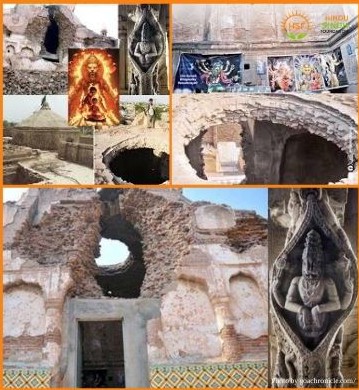
Prahladpuri Temple, located in Multan, is traditionally believed to stand at the very site where Holika was burned.
According to ancient belief, the original temple was built by Prahlada himself. For centuries, it was one of the most revered pilgrimage sites in the Indian subcontinent. Devotees traveled from distant regions to offer prayers and commemorate the divine miracle associated with Holi.
The temple stood resilient through centuries of political upheaval and invasions. It was rebuilt multiple times by Hindu rulers and devotees who considered it a sacred symbol of faith and heritage.
From Ashes to Colors: How Holi Evolved
After the burning of Holika, it is said that people applied the sacred ash from the pyre on their foreheads as a blessing- a practice that continues in some communities even today.
Over time, this ritual transformed. Ash gave way to colored powders, symbolizing joy, renewal, and the vibrant energy of spring. What began as a solemn reminder of divine justice evolved into a festival of unity, celebration, and harmony.
The Temple’s Later History
Prahladpuri Temple remained a significant pilgrimage center in the pre-Islamic period and for many centuries thereafter. However, the site faced repeated damage over time.
In 1992, the temple suffered severe destruction during communal unrest. Eventually, the site came under government control, and a madrasa was constructed over parts of the historic location.
Today, little of the original structure remains. Yet its spiritual legacy continues to live on through the celebration of Holi across the world.
Holi: A Festival Beyond Borders
Although the physical structure of Prahladpuri Temple may no longer stand in its original glory, the story it represents continues to inspire millions.
Every Holika Dahan bonfire lit across India and beyond is a tribute to:
-
The faith of Prahlada
-
The fall of arrogance
-
The destruction of evil
-
The protection of devotion
As we gather around the sacred fire this Holi, we are not merely performing a ritual — we are remembering a story that began centuries ago in ancient Multan.
Celebrating Holi 2026 with Meaning
This Holi, let us go beyond colors and sweets. Let us celebrate:
-
Faith over fear
-
Truth over tyranny
-
Love over hatred
-
Light over darkness
From the sacred flames of Holika Dahan to the joyful burst of colors the next morning, Holi remains one of the most powerful reminders that righteousness always prevails.
Wishing you a vibrant, meaningful, and joyous Holi! 🌸🔥🎨