For much of its long history, Multan was not only a center of Islamic learning and Sufi spirituality, but also one of the most important Hindu pilgrimage cities in the northwestern Indian subcontinent. Long before Partition reshaped the religious landscape of Punjab, Multan stood as a shared sacred space where multiple faiths flourished side by side.
Multan Before Islam: A Major Hindu Pilgrimage Center
When the Chinese Buddhist monk Xuanzang visited Multan in 641 AD, he recorded the presence of a magnificent Sun Temple, housing a gem-studded idol of Surya, the Hindu sun god. The temple was renowned across the region and drew pilgrims, wealth, and patronage, making Multan an important religious and economic hub.
Muslim Rule and the Survival of Temples
In the 8th century, Multan came under Muslim rule for the first time following the Arab conquest led by Muhammad bin Qasim. Unlike many other regions, Multan’s temples were not immediately destroyed. Their immense economic importance—particularly the revenue generated by pilgrimages—ensured their survival. For nearly three more centuries, Hindu religious life in Multan continued alongside Islamic governance.
The Mystery of Destruction
The eventual destruction of Multan’s great temples remains unclear. Historians speculate that it may have occurred under the Ismaili emirs in the 10th century, or during the raids of Mahmud of Ghazni in the 11th century. What is certain is that when the polymath Al-Biruni visited Multan in the mid-11th century, the famed Sun Temple was already in ruins.
Yet even after the destruction of its most famous shrine, Multan did not lose its importance in Hindu religious life. The city remained a center of Hindu learning, and some scholars believe that the festival of Holi may have originated here.
Mughal Era Connections and Continued Pilgrimage
During the reign of Emperor Akbar, a Multani trader named Kapur Ram Das played a pivotal role in Hindu religious history by funding the construction of the Madan Mohan Temple in Vrindavan, one of Hinduism’s most sacred towns.
Several generations later, during the reign of Aurangzeb, the French traveler Jean de Thévenot noted that Hindu pilgrims still traveled from distant regions to Multan, confirming that the city retained its spiritual importance well into the Mughal period.
Multan on the Eve of Partition
Just six years before Partition, Multan was a remarkably diverse city:
-
57% Muslim
-
40% Hindu
-
2% Sikh
-
0.4% Jain
However, the Partition of 1947 brought an unprecedented and violent transformation. Unlike Sindh—where a significant Hindu population remains to this day—Pakistani Punjab experienced a near-total forced population exchange. Multan’s Hindu population collapsed to approximately 0.1%, leaving behind temples, homes, and businesses that suddenly had no caretakers.
The Abandoned Gopal Madan Mohan Temple
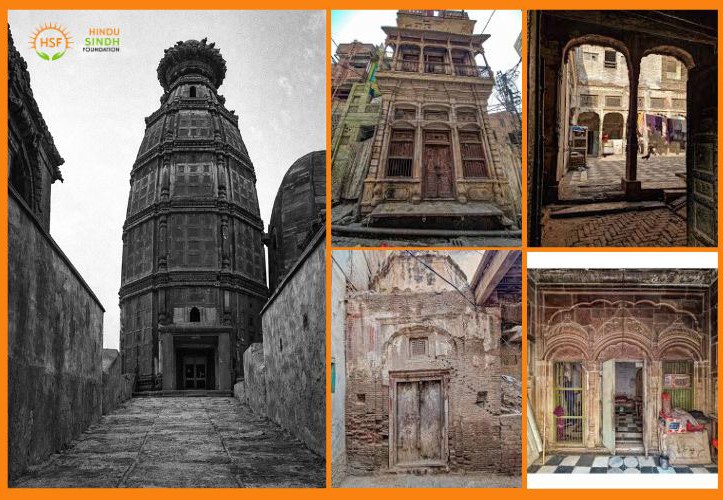
Among the surviving remnants of this lost community is the Gopal Madan Mohan Temple, now abandoned and largely forgotten. Intriguingly, it is dedicated to the same deity—Madan Mohan (Krishna)—as the famous temple in Vrindavan, linking Multan spiritually to one of Hinduism’s most sacred landscapes.
Adjacent to the temple stands what appears to be an old Shivalaya, indicating that the complex once supported multiple forms of Hindu worship.
An Inscription That Preserves Memory
A surviving inscription offers rare clarity amid the ruins. Engraved by Goswami Lalit Kishor, it records that:
-
The deities were brought to Multan in 1849
-
The temple was formally inaugurated in 1864
-
Goswami Kishor himself appears to have served as the temple’s priest
-
Construction and upkeep were funded by Notida Chaudhury
Notably, the temple owned the surrounding shops, whose rental income sustained religious activities—demonstrating how temples functioned not only as spiritual centers but also as economic institutions embedded in urban life.
A Silent Witness to Multan’s Plural Past
Today, the abandoned Gopal Temple stands as a silent witness to a vanished world. Though neglected, it remains a powerful reminder that Multan’s identity was once shaped by shared sacred spaces, diverse communities, and centuries of coexistence.
Preserving the memory of such sites is not merely about restoring old buildings- it is about acknowledging the layered, plural history of a city that has long been a crossroads of faith, culture, and civilization.